
How to Run ChatGPT Ads with Google Ads: The Playbook For Combined Success

Summary
To run ChatGPT ads well, you must target conversation context, write helpful, answer-adjacent copy, and send traffic to AI-readable pages that resolve the exact problem the user just described.
Google Ads still matters for conversion harvesting. ChatGPT ads win earlier by shaping the decision frame. So stop writing keyword-led ads. Write problem-led ads that extend the AI’s answer.
Use the C.H.A.T framework: Context-aware, Helpful-first, Answer-adjacent, Two-way ready. Then build landing pages that match the conversation and remove friction fast.
Key takeaways
ChatGPT ads are clearly labeled and separate from the AI answer. You are buying proximity to intent, not control.
Targeting is contextual, not demographic-first. Think “problem narratives,” not keyword lists.
Your site must be structured for AI extraction. Schema and FAQs are now performance assets.
Measurement will skew toward influence and lift, not perfect last-click attribution.
The fastest path is a stack: ChatGPT Ads + Google Ads + CRO + content matrix.

Table of contents
What we know about ChatGPT ads
Why your Google Ads playbook breaks in ChatGPT
The CH.A.T. playbook for running ChatGPT ads
How to run ChatGPT ads step-by-step
How to pair Google Ads and ChatGPT ads for profit
Website fixes that improve AI answers and ad ROI
What to measure when tracking is imperfect
A 90-day execution plan
FAQ
Need help building your AI + ads content strategy?
What we know about ChatGPT ads in 2026
OpenAI says ChatGPT ads are clearly labeled, separate from answers, and should not influence responses. They also emphasize privacy and user control.
ChatGPT usage scale is already massive. Similarweb reported ~5.7B visits in January 2026.
OpenAI also shared that users send ~2.5B prompts per day (via Axios reporting).
Q: Are ChatGPT ads “search ads”?
A: No. They show up after an answer, inside a decision moment.
Why your Google Ads playbook breaks in ChatGPT
Google Ads rewards great keyword intent coverage. ChatGPT ads reward great problem coverage.
On Google, you compete for a click. In ChatGPT, you compete for “that helps.”
Google queries are often short. ChatGPT prompts are long and emotional. They include constraints and tradeoffs.
Also, ChatGPT ads sit below the AI response. So the user already got “the answer.” Your ad must feel like the next step.
A feature list starts looking incompatible with the way data is presented.
“Best price” sounds like spam.
“Bad companies are destroyed by crisis, good companies survive, great companies are improved by them.” — Andy Grove
ChatGPT ads are coming, and users are flocking towards this new internet. You should not “wait and see.” You build new muscles before the fight.
The CH.A.T. playbook for running ChatGPT ads
This is the simplest model that can help you begin populating and writing content that fits the conversational interactive style of ChatGPT.
C = Context-aware
Your ad must match the exact problem shape being discussed.
Not “CRM software.”
Yes “Stop deals dying from missed follow-ups.”
Q: What is “contextual targeting” in ChatGPT ads?
A: It is relevance based on the current conversation topic and intent, not cookies and past browsing.
H = Helpful first
Your ad should extend the answer, not fight it. Lead with:
a checklist
a template
a calculator
a short diagnostic
Then earn the click.
A = Answer-adjacent
Assume the user will compare your ad to the AI response.
If your landing page restarts at “Welcome to our platform,” you lose.
Your page must begin with “Here is the next step.”
T = Two-way ready
If ads evolve toward in-ad follow-ups, static pages will underperform. Build pages that support dialogue with:
dense FAQs
comparison tables
“if this, then that” sections
live chat or guided flows
“Only the paranoid survive.” — Andy Grove
Assume your old playbook is expiring. It could be today, next month, or next year. But accept it is changing. So test small, learn fast, ship weekly changes.
How to run ChatGPT ads step-by-step
ChatGPT ads will continue to evolve, so treat this as a prep-to-launch system.
Step 1: Build your “problem library”
Write 25–50 problems your buyers actually say.
Examples:
“We get leads, but no shows.”
“We spend on ads, but margins vanish.”
“Sales cycles are stalling.”
Step 2: Map each problem to one “next page”
Each problem gets a single page that includes:
Answer-first opening
5–8 FAQs
1 comparison block
1 proof block (reviews, case study, numbers)
Schema
Write headings as natural questions. Mirror user phrasing from ChatGPT prompts.
Step 3: Create three ad angles per problem
Fix angle: the fastest path out.
Avoid angle: the common mistake.
Proof angle: “we did this before.”
Keep copy tight. Try to use the same words buyers use.
Step 4: Add “AI referral” measurement now
You need to establish a baseline before spend. ChatGPT processes 2.5B prompts per day, and AI referrals will keep rising.
Track:
AI ref traffic segment
branded search lift
assisted conversions
time-to-lead
Step 5: Start with narrow tests
Run small budgets by intent cluster, not broad categories. If you cannot explain why the ad appeared, you targeted too wide.
How to pair Google Ads and ChatGPT ads for profit
You do not pick one. You stack them. Use ChatGPT ads for discovery and direction. Use Google Ads for capture and closure.
How to run google ads in this combo:
Bid on the “bottom-funnel” keywords.
Keep landing pages short and direct.
Use strong offers and clear proof.
How to run ChatGPT ads in this combo:
Build campaigns around problem narratives.
Lead with help and a micro-commitment.
Make landing pages conversation-ready.
If you must choose one:
Google captures demand that exists.
ChatGPT shapes demand before it forms.

Website fixes that improve AI answers and ad ROI
If your site is hard for AI to parse, your ads work harder.
Fix 1: Write FAQ blocks that sound like prompts
“How much does this cost per month?”
“What happens if I already have a vendor?”
“Is this better than Google Ads for my business?”
Fix 2: Add schema that matches your page intent
Use:
Article
Organization
FAQPage
Service
Review (when legit)
OpenAI’s own research stresses scale and structured analysis approaches. Use that mindset on your site.
Fix 3: Add comparison sections
AI loves explicit comparisons because users ask for them.
“ChatGPT ads vs Google Ads”
“Best option for X constraint”
“When not to use ChatGPT ads”
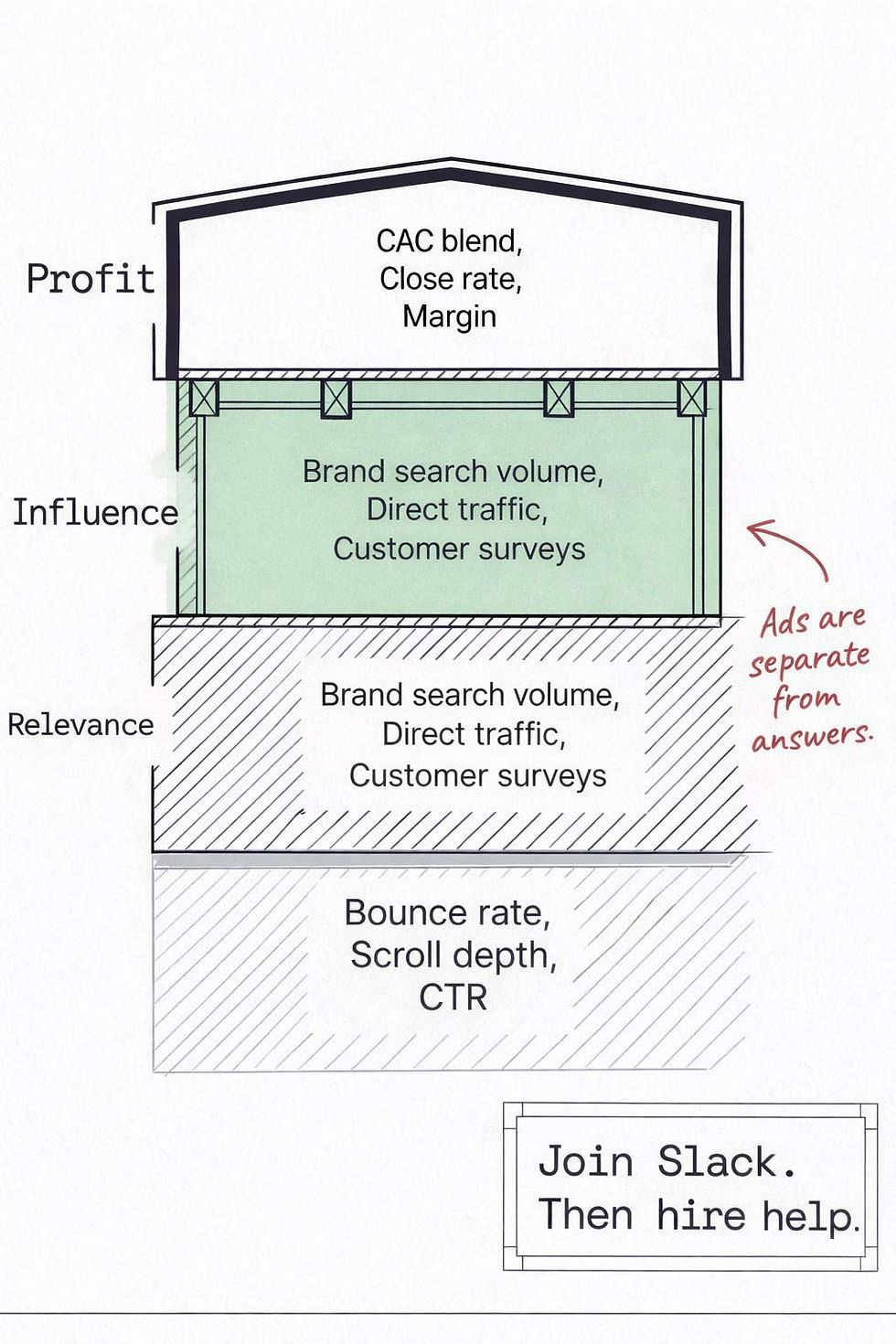
What to measure when tracking is imperfect
Do not wait for perfect attribution. It will not arrive.
Track three layers:
Layer 1: Relevance signals
bounce rate by landing page
scroll depth to FAQ
click-to-lead rate
Layer 2: Influence signals
branded search growth
direct traffic lift
“How did you hear about us?” responses
Layer 3: Profit signals
CAC by channel blend
lead-to-close rate
gross margin per booked job
Q: Why will last-click get worse?
A: People may discover you in AI, then convert elsewhere. OpenAI’s ad approach is designed around user control and privacy. Expect fewer deterministic trails.
A 90-day execution plan

Days 1–30: Foundation
Build 10 problem pages.
Add FAQ schema.
Rewrite top landing pages answer-first.
Days 31–60: Content matrix
Publish 8 support posts.
Add 4 comparison pages.
Add 2 case studies.
Build a simple “choose your path” page.
Days 61–90: Authority and scale
Collect review velocity.
Earn 3 credible mentions.
Expand to 25 problem pages.
Increase spend only on winners.
Need help building your AI + ads content strategy?
Join the ChatGPT Ads Strategy Slack community first. You’ll see real tests, templates, and what is working right now.
If you want execution help, ChatGPT Ads Strategy can build the full stack: ChatGPT ads prep, Google Ads, CRO, and the content matrix that makes both channels cheaper over time.
FAQ
What are ChatGPT ads?
ChatGPT ads are labeled, sponsored placements that appear separate from the AI answer, designed to be relevant to the conversation topic.
Do ChatGPT ads replace Google Ads?
No. They change discovery and consideration. Google still captures high-intent searches.
How do I run ChatGPT ads if the platform is new?
Prepare the pages, the problem library, and the measurement. Then test small.
How do I show up in AI answers without paying?
Use structured pages, FAQs, comparisons, proof, and schema.
What should I do this week?
Write 10 problem pages and add FAQ schema. Then clean up your conversion path.
Key Takeaways and Next Steps
“We are stubborn on vision. We are flexible on details.” — Jeff Bezos
Need help running ChatGPT Ads and Google Ads together?
If your ads are not converting, it is rarely “the platform.” It is usually the offer, the page, or the mismatch.
ChatGPT ads will punish lazy copy. They will reward helpful structure. That is the whole game.
Build ads that extend the answer. Build pages that welcome follow-ups. Then use Google Ads to harvest demand.
Sources and suggested links
Join Business Owners in the ChatGPT Ad Strategy Slack Community
We're actively discussing where conversational AI fits into paid media strategy, sharing early learnings, and building the tactical playbooks


Comments